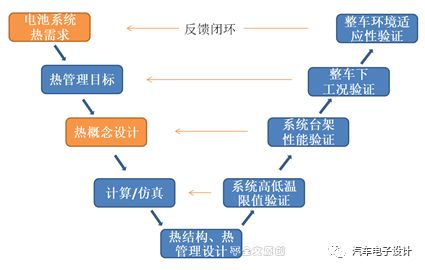
The design of a battery thermal management system is one of the most critical external factors that ensure the safe and efficient operation of the battery. It plays a key role in enhancing performance metrics such as battery life and overall system reliability. This aspect directly determines the success or failure of the entire battery system, and it can even lead to the rejection of an entire design if not properly addressed. From a thermal design perspective, there are many interconnected elements, much like finding balance on a fulcrum. The ultimate goal of the technical implementation is to ensure that all chemical cells within the system operate under "comfortable" and "uniform temperature" conditions. Achieving this allows multiple batteries to perform in harmony, maximizing their potential.
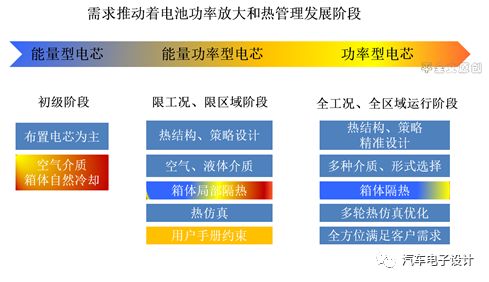
In the early stages of vehicle power battery system design, battery layout was often overlooked. The systems were open, filled with batteries, and thermal management was either difficult to trace or neglected as a key component. However, in recent years, this situation has changed significantly. Customers now demand “reducing the usage gap†compared to fuel vehicles. From both a power and environmental adaptability standpoint, higher requirements have been placed on battery systems, giving thermal management a new and crucial role. To meet these demands, a scientific and comprehensive development process is essential, where each small detail is carefully considered and treated seriously, ensuring that the thermal design meets the necessary standards for the battery system.
1. The entrance based on the positive development of the V model: three key “needs,†which can be clearly understood.
In fact, the design of all components is driven by “requirements.†However, after years of experience, it has become clear that problems often arise from the “requirement†stage. Many issues start off vague or ambiguous, leading to last-minute fixes or even complete redesigns, which can be costly. Therefore, at the beginning of the design phase, it's crucial to “think clearly,†so that subsequent work can proceed smoothly and with clarity.
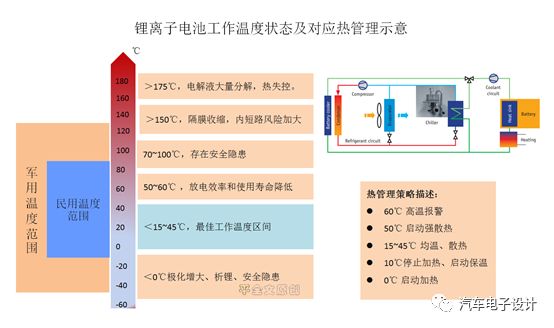
1) One of the key requirements: the application of the “region†is clear, and meeting environmental requirements is the first priority.
From a cost perspective, designing for “full-temperature†environments is not always well-received. Lithium-ion batteries such as NCM, NCA, and LFP have very limited temperature adaptability and rely heavily on thermal management to maintain performance. However, the broader the environmental adaptation, the larger the temperature range, and the more technology and cost are required (in both hardware and software). How to balance this? Here are a few considerations:
Measure 1: Design different versions of thermal management. While we strive to maximize driving range, most vehicles and customers still consider new energy vehicles as medium-to-short-range, point-to-point vehicles. Their operating range is still smaller than that of traditional cars. For example, designing for alpine regions when the vehicle is used in southern areas would be unreasonable and uneconomical. Today, “user precise positioning†is becoming a major trend in design.
Measure 2: “Notify the customer.†For instance, in the early version of the Leaf, the user manual stated: “Do not leave the vehicle in a location above 49°C for more than 24 hours; do not place it in a location above -25°C for more than 7 days.†Any product must meet the needs of the majority of users. When facing “minority†cases, it’s important to communicate clearly with the customer. This is a reasonable and practical approach.
Measure 3: Start from the root and choose the right battery type. For example, LTO batteries offer significantly improved low-temperature performance. If power and energy density requirements are not high, they can be considered as an alternative. (This will not be discussed further in this article.)
2) The second key requirement: the battery system’s power boundary SOP, testing the thermal management temperature limit control capability.
The forward design of the vehicle places great importance on power demand, which determines the quality of the power performance. The power boundary of the battery system is largely determined by the thermal management’s ability to control temperature limits. In general, the first step involves introducing the vehicle’s power requirements. Then, the battery system decomposes the technical specifications, selects the battery core, and chooses the appropriate thermal management mode. However, the battery system may not fully match the whole vehicle’s performance curve, requiring prioritization of the vehicle’s safety.
The third key requirement: the system temperature difference design goal, mainly reflecting the thermal management capability.
I believe this is the essence of thermal management design. Although strong high-temperature control capabilities solve the issue of safe battery operation, they also reflect the battery’s performance and lifespan—this is the “system temperature†capability. Tesla maintains a system temperature difference of less than 2°C, which not only shows its thermal management capabilities but also highlights the long-term durability of its models, such as the Model S and X, which can achieve over 150,000 miles with minimal battery capacity loss (less than 10%). This is a proven truth.
The average temperature design comes from the thermal structure, cold medium quality, and control strategy, which are relatively straightforward. However, there is another important factor that is often overlooked: the “insulation†design (structural material and control strategy). Insulation measures are the most effective way to manage the rate of temperature change. On one hand, they help cool down faster during high temperatures (reducing the impact of external environments). On the other hand, they slow down heating during cold weather, making it more convenient for users and simplifying thermal management designs for ambient temperatures slightly below 0°C.
2. Do not ignore one of the key elements: the heat transfer of the cell body is not as good as expected, and the system temperature point layout needs calibration.
Whether it is cylindrical, square, or soft-pack batteries, they are composed of multi-layer pole pieces. For example, a brand of square batteries with 45Ah capacity consists of 23 positive electrodes + 24 negative electrodes + N diaphragm + several electrolytes. Let’s first look at the thermal conductivity of the relevant materials as shown in the figure:

(Note: The data in the table may vary due to test methods, for reference only)
From the material perspective, the composition of the cell and metal materials differ greatly. This means that the temperature on the surface of the battery takes a long time to reach the innermost layer. More importantly, the temperature uniformity characteristics become very poor. From the perspective of battery manufacturing technology, there are more differences affecting heat transfer and temperature uniformity:
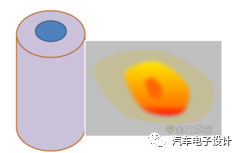
First: There is a temperature difference between the same pole piece (due to coating thickness processes).
Second: The lamination process creates different heat transfer paths (the winding process conducts heat along the platinum sheet, while the lamination process conducts heat vertically).
Third: The temperature of the pole ear does not fully represent the highest temperature in the center of the pole piece. (The poles are connected to the pole pieces via connecting pieces, and the process and materials vary.)
Through the above analysis and comparison, the arrangement of temperature collection points on a single cell is uncertain. Additionally, modules and packages made up of individual cells are completely different due to variations in structural design and arrangement. The layout of temperature points must be calibrated through testing. For example, the Leaf battery system has four collection points distributed across different positions in the cabinet. Nissan is confident about the number of collection points, but behind it, countless rounds of experiments have been conducted, and the hard work involved in this development is unknown.
Don’t ignore the second key element: the selection of thermal interface materials.
In the figure, 1345 is related to heat.
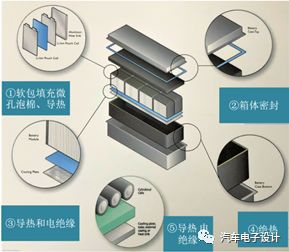
1) Used in the role of the battery 1: heat conduction and insulation. At first glance, it seems contradictory. In normal operation, during charging and discharging, we hope that its thermal conductivity is good, ensuring the system’s temperature uniformity. But during faults, such as short circuits or thermal runaway, we want it to be insulated to protect adjacent cells.
2) When used between the battery and the heat-conducting plate 3, we require not only good thermal conductivity but also uniform heat conduction and good insulation. This is also a contradiction. From a material perspective, thermal conductivity and insulation are affected by added ingredients. Below the interface material data, you can see some material selection characteristics for reference.
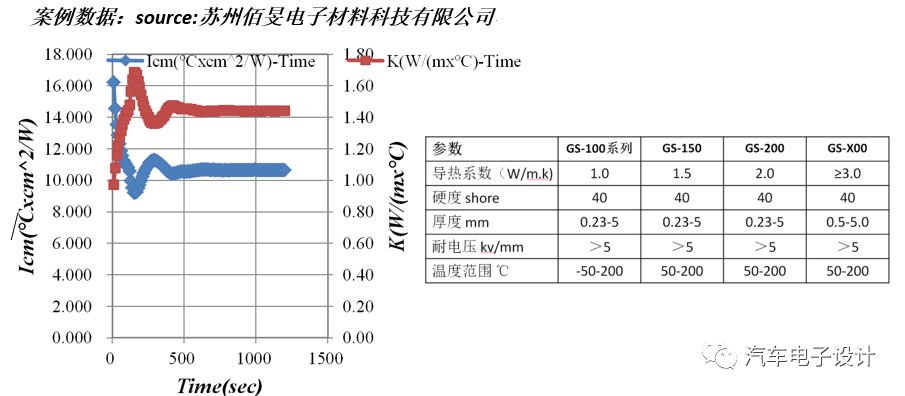
Case data: Source: Suzhou Hao Electronic Materials Technology Co., Ltd.
In addition to the above choices for correlating thermal and electrical properties, there is also a structural choice. During charging and discharging, the cell expands slightly. At this time, it is necessary to absorb this variation structurally. The interface material naturally acts as a “buffer.†In short, although the accessories are small, they have a significant impact. A good “choice design†is needed. Also, there is a “choice†in terms of brand. Currently, the market has mixed quality, and some products are sold at ultra-low prices. Don’t lose out because of small details. I have witnessed cases where a small thermal pad had to be reworked. Choose a manufacturer that focuses on experimental capabilities and speaks with real data.
Three system cabinets with partial insulation that cannot be ignored.
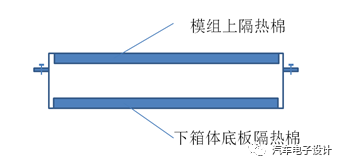
For the design of the water-cooling system, we have implemented some insulation design locally. The main function of the lower floor insulation is to prevent high-temperature radiation heat transfer from the ground. The insulation cotton above mainly blocks heat transfer from the battery system to the body or cabin. From a safety perspective, the insulation effect is also significant. If the battery system fails, it can help relieve and protect the passenger compartment. Although the cabinet cannot be completely insulated for various reasons, the precise design of the battery system’s heat requires proper thermal insulation design.
Don’t ignore the fourth key element: a naturally cooled battery system also requires thermal management design elements.
Many times, we assume that natural cooling relies solely on the cabinet without active design elements. However, this view needs to be revised.
1) Airflow diversion channel of the outer casing of the battery system.
I have discussed this with many experienced structural engineers, and they strongly agree. When the battery charge and discharge rate is 1–2C, and the ambient temperature is sufficient, natural cooling is reasonable. With this cooling, the cabinet naturally becomes a “heat sink.†When the vehicle moves, the box shape is designed to guide airflow, and the gap between the battery box and the body is also required.
2) Floor area ratio of battery arrangement.
This is something everyone understands. When using natural cooling, increasing the spacing between cells is beneficial. From the perspective of natural convection, a cell gap of 5–10mm can form an effective channel. At the same time, there are large convection channels between the modules and between the modules and the cabinet. I have done an analysis showing that a void volume ratio of 40–50% makes natural cooling the most effective.
Summary
This article shares some insights from my work. In the thermal design process, there are actually two crucial factors: one is “understanding chemical batteries.†Many engineers who work on thermal design and simulation come from other fields. This interdisciplinary understanding is something that needs to be learned. Only by truly grasping the concept can you realize that thermal system design is not just about controlling high or low temperatures—it’s just one small step in your design. The true goal is the “average temperature†of the system and your ability to achieve it. Another key factor is the “thermal model of the battery,†a concept that has been around for many years. Everyone is working on it quietly, but my understanding is still limited, and the data is incomplete. This article doesn’t cover it, and it will be left for future thematic discussions.
The above introduction outlines the “step-by-step†process required for successful thermal design. It emphasizes the need to incorporate many elements into the process, starting with “clear requirements†and making the thermal design clear and well-defined. At the same time, the “key†elements must be fully considered and completed. Through continuous effort, we believe we can design first-class products.
MRS-Double Poles Rocker Switch
Features
â—† Wide Application
Widely used for various kinds of electrical products, instrument, car, boat, household appliances such as lights, water dispenser, treadmill, coffee pot, speaker, electric car, motorcycle, TV, massage machine etc.
â—† High Operating Life
Made of high quality polyamide eP(Nylon PA66) material, this sturdy mini boat Rocker Switch is born for anti-corrosion,anti-acid and high resistant with silver terminals.100,000 times of ON/OFF operating life span.
â—† Easy Installation Auto
Easy to implement into all kinds of electronics projects, just drill a hold the right size and it slides straight in.This inexpensive rocker switches are always good to have around.
Double Rocker Switch,Double Pole Rocker Switch,2 Pole Rocker Switch,Electrical Rocker Switches
Ningbo Jialin Electronics Co.,Ltd , https://www.donghai-switch.com